
Delta Airlines Releases Earnings on July 13
This coming Wednesday, July 13 Delta Airlines will release earnings, and preside over a conference call that will focus mostly on load factors, fares, pilot shortages, and fare profitability. If the disclosure and investor call follow the script of past earnings’ releases, little will be said about the contribution from the Monroe Energy subsidiary, which harbors the 185,000 b/d refining plant that Delta bought from ConocoPhillips ten years ago.
The scale of the plant’s profits may be a prelude to pending earnings for public major and independent refiners later this month.
And what a prelude it looks to be.
An analysis of prices for the key transportation fuels produced at the plant suggests never-before seen margins thanks to most refined products values moving to extra-orbital numbers relative to crude.
The 185,000 b/d refinery has perhaps the largest jet fuel yield in the country, thanks to Delta’s desire to get much of its Northeastern needs for aviation fuel from the plant. At the first quarter conference call, top Delta brass put the jet fuel yield at about 20%, far above the normal eight or nine percent yield of other plants that make 54 Grade Jet. That points to about 37,000 b/d of jet fuel production.
Gross margins in the second quarter were staggering. At one point, spot prices for jet fuel in the Northeast easily topped $7/gal, and the final quarterly average was $5.0629/gal or approximately $212.64 bbl. Even with front month Brent averaging $111.98/bbl in the period, the implied margin topped $100/bbl.
Quarterly Gross Margins for Northeastern Fuels
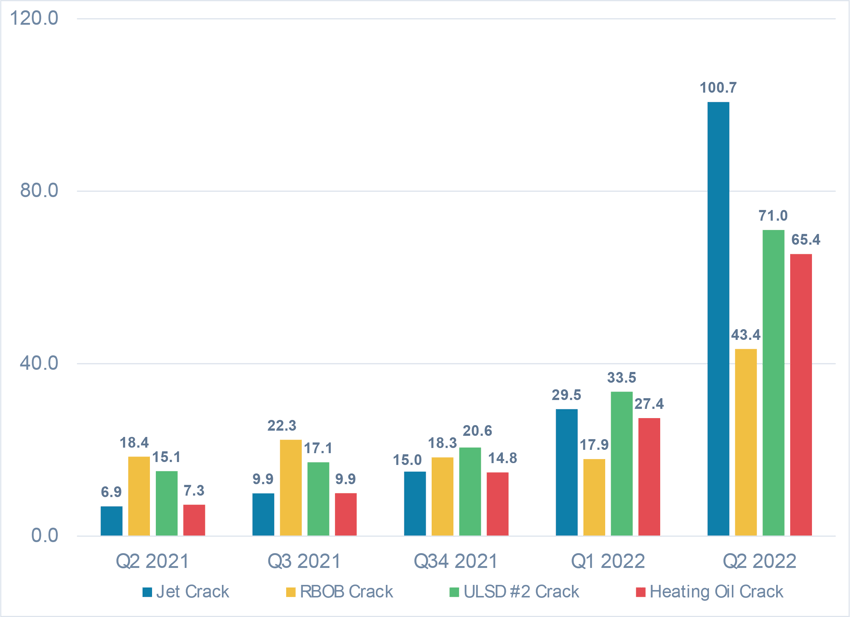
Diesel and ultra-low sulfur heating oil also saw off-the-charts returns. Diesel commanded an average price of $43.3561 gal in the quarter, pushing the gross profit to about $70.97/bbl. Heating oil fetched an average $4.2237/gal for a gross return of about $65.42/bbl.
Note: the comparisons use an average 2Q22 Brent price of $111.98/bbl and the 2021 Brent average was $69.08/bbl.
Northeast Refining Margins – Now and Then (2Q2021 vs. 2Q2022)
| Commodity | 2Q21 Crack | 2Q22 Crack | 2022 Increase |
| NY ULSD | $15.07/bbl | $70.97/bbl | +$55.90/bbl (+371%) |
| NYULSHO | $ 7.29/bbl | $177.40/bbl | +$ 58.13/bbl (+797%) |
| NYJetFuel | $ 6.91/bbl | $100.66/bbl | +$ 93.75/bbl (+1357%) |
| NYRBOB | $18.42/bbl | $ 43.40/bbl | +$ 24.98/bbl (+135%) |
Gasoline represents the obsession of scores of millions of consumers, and profits there were sensational, but not nearly as staggering as distillate. Delta’s Monroe Energy subsidiary tends to swap much of its gasoline and diesel for jet fuel in other sections of the country. The quarter saw RBOB command an average price of just under $3.70/gal, and that was good enough for an implied gross margin about 135% higher than second quarter 2021.
One key inquiry may come from investment analysts on the conference call. Monroe Energy had accrued a huge liability for Renewable Identification Numbers or RINs, with hundreds of millions of dollars owed on the regulatory instruments.
“There is no excuse with current fuel margins not to pay up,” noted one biofuel expert who suggested that Monroe has enjoyed windfall profits that vastly exceed its regulatory liability.
OPIS looked at the Renewable Volume Obligation during the quarters analyzed in the unprecedented year-on-year comparison. Somewhat ironically, RVO costs – representing a basket of RINs that pure merchant refiners are responsible for paying—averaged 18.427cts/gal in the recent quarter, which was down from 19.39cts/gal in 2Q2021. Put another way, the per barrel responsibility was about $7.94/bbl in the second quarter of 2022, compared with a hypothetical obligation of about $8.15/bbl in 2021.
Delta probably won’t release any real details on Monroe’s performance until if files a 10-Q with the Securities and Exchange Commission after earnings and the conference call.
The refinery was purchased in 2012 for $180 million. At the time, it was a price well below what the carrier might pay for modern jet aircraft. Top brass at Delta once rued the purchase, largely because operational costs exceeded the purchase price in many years. Even before COVID, executives sought a joint venture partner or a buyer, people familiar with the matter told OPIS.
Like many refiners, there was much suffering during COVID and even in 2021 when RVO costs soared. Delta always maintained that the refinery was a solid investment since it cheapened the cost of jet fuel throughout the North Atlantic. This week, it may indeed overshadow some of the traditional bottom line numbers in the carrier’s earnings scorecard.
© 2022 Oil Price Information Service, LLC. All rights reserved.
